Barcelona and the Geography of Food
Barcelona is a city of plenty. The river Ebro gathers its waters from the mountain streams and when it reaches the Mediteranean just below Barcelona it drops its sand and silt and it forms a delta that is a rich marshland incubator for baby fish. Food comes in all directions to this port city, goat and sheep cheeses from the mountains, grain, olive oil and vegetables from the plains, and seafood from the Mediterranean. My brother and I made a short visit there last November, and we just began to sample the food and culture before it was time to leave. Here I simply try to capture the feeling of being in Barcelona for a few days, as there is so much written about this city. But with regard to geography of food, it is no accident that Barcelona has thrived since the days of the Romans. The same wealth of food guides the migration of birds to the Ebro Delta, where flamingos nest in the summer and huge flocks of geese spend the winter, coming south like the pale, sun-seeking tourists from Northern Europe.
We arrive in Barcelona on a cool November afternoon and a cab takes us to our apartment hotel along broad, tree-lined avenues. As in central Paris, the buildings are kept to a human scale. Blue skies and white clouds highlight the beauty of the city until interrupted by light showers. It is good weather for city walking. We are there in the week before the referendum on Catalan Independence, and yellow and red striped Catalan flags drape the wrought iron balconies of the apartment buildings. The flag, called the Senyera, has four red bars on a gold background that represent the coat of arms of the old kingdom of Aragon.

Kitchen of Erik Vogel Apartment
The taxi is not too expensive. I am always willing to pay $30 to avoid the stress of finding my way in an unknown city while lifting and wheeling my bags on and off buses and subway cars, endangering my back and shoulders and watching for the pickpockets who prey on the obvious tourist. Once I have dumped my luggage at my hotel, however, bring on the public transport or, better yet, my walking shoes. Our French friend Jean-Michel prides himself on never using taxis, but if I have luggage and the price is reasonable, please hail me a cab!
We have a two-bedroom apartment in a dense residential neighborhood near the Sagrada Familia, Gaudi’s magnificent church and symbol of Barcelona. We wheel our bags up an alley to the entry, where the attendant is present only because he expects us. Later, we discover that he is usually not there, so we should have grabbed laundry detergent and coffee pods then and there, but we did not. The Eric Vogel apartment-hotel chain converted the interior of an older building into sleek Scandinavian modern apartments. Ours has a small glossy kitchen with all the stainless steel mod-cons squeezed in. There is a pleasant living/dining room and two comfortable bedrooms. The rooms look out on the quiet alley rather than a noisy street. I get the master bedroom with its own bath and my brother takes the smaller room with adjacent bath.
Later we buy milk and a large supply of pods for the coffee maker. Nescafe coffee pods turn out to be the norm during our whole trip, whether in our apartments or in hotel breakfast rooms. Since we both drink several cups of coffee in the morning this is not the last box of pods we buy. The coffee maker is the only appliance we master on our trip. We do use the oven, microwave, and clothes washer in the three apartments we stay in during this trip, but spend a long time pouring over the instruction manuals before managing to use them.
After settling in, we walk a few blocks to a commercial street near the Sagrada Familia and find an outdoor café with a view of the Basilica for a light lunch. Propane heaters keep us warm on a chilly afternoon. Afterwards we walk around the enormous building, circling it, taking in the extravagant exterior. Workmen scramble over the scaffolding, still completing the building after so many years.

Eating outside in November with a view of the Sagrada Famila
We buy a good bottle of wine at a neighborhood wine shop and the salesman recommends a tapas style bar/restaurant nearby where we go for an early dinner. The restaurant is called Belota, after the most expensive acorn fed ham from Extremadura. It specializes in the thin translucent slices of jamon, or Spanish ham that resembles Italian prosciutto and is one of the staple foods of Spain. Whole hams hang on the wall, and others are set up in wooden cradles that support them while the server slices paper-thin pieces. One can choose from various types of ham. The food is excellent.
After dinner we sit with our coffee at an outside table and my brother chats with the waiter in Spanish. I understand the conversation, although I don’t have his ability to speak easily. The man talks about the difficulties the restaurant business has had since the economic slow down and how they had to lower prices and work on a narrow margin. In the current economy, Barcelona is not a city of plenty for everyone. Back at the apartment, as we prepare for bed, we are startled by a loud racket up and down our narrow alley. At 10 pm every night the local residents go out onto their balconies or stand at open windows and bang pots and pans together to encourage the vote for Catalan independence.
Our days in Barcelona begin with Gaudi. On our first morning, we walk south for a mile to Casa Mila, one of the apartment buildings designed by Gaudi and also known as La Pedrera. It is on the Passeig de Gracia, one of the large tree-lined avenues in the heart of Barcelona. Once we locate the Gaudi building, we find a sidewalk café for a late breakfast of good coffee, delicious pastry and people watching. The café is expensive because of its location, but it is a fun exception to our budget rules. Anyhow, another budget guideline is that breakfast is the cheapest meal to enjoy in an expensive and scenic café.
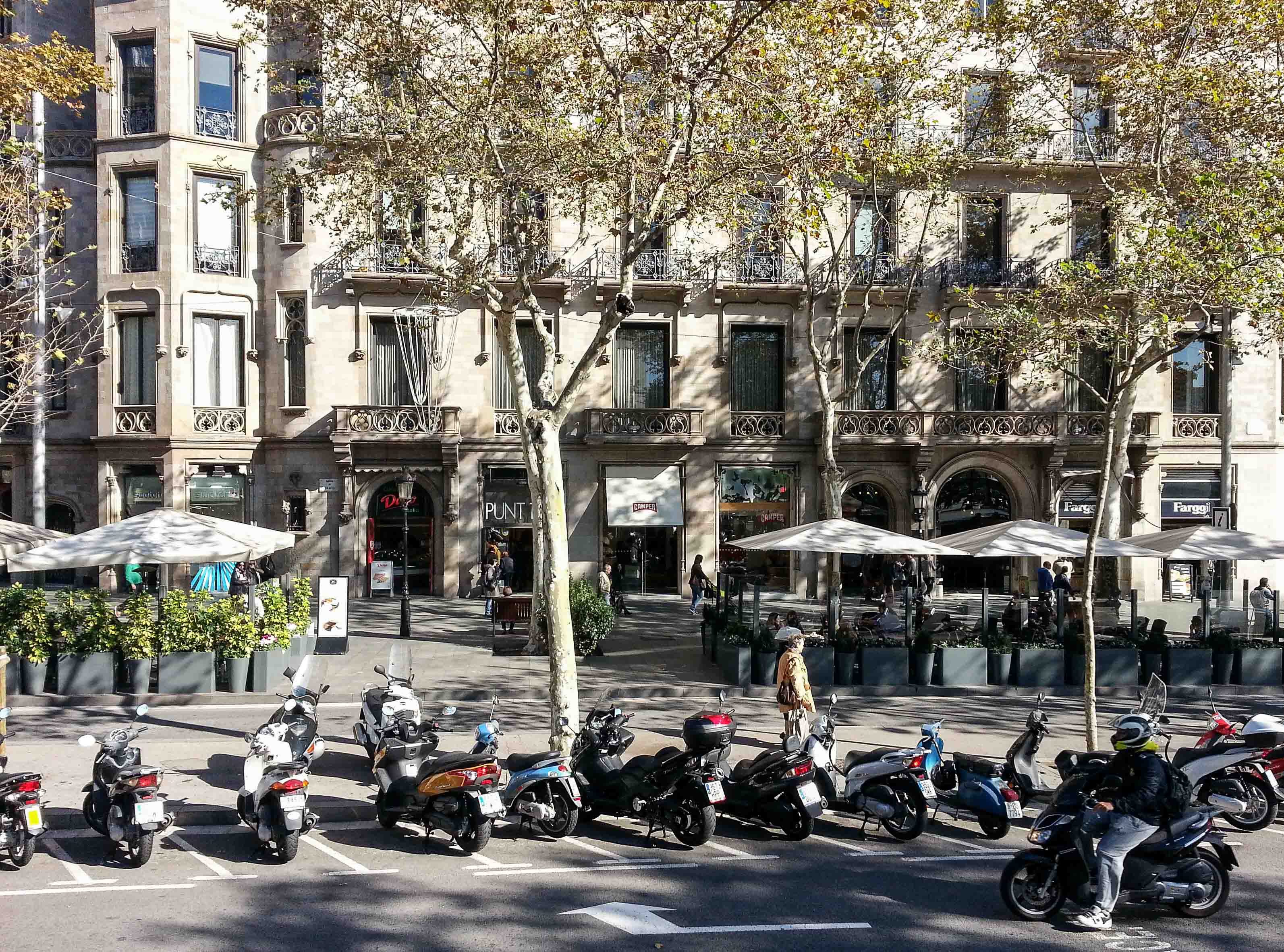
Cafe on the Paseig de Gracia
Refreshed, we return to La Pedrera, which means Stone Quarry and is the popular name for this curvaceous building, whose rounded balconies look like water-etched entries to limestone caverns. Sadly, for our visit the exterior is being restored and is covered with scaffolding and protective mesh screening. Most of the apartments are inhabited, but tourists can visit the top floors and roof. We clamber up and down the steps that connect the uneven sections of the fairy tale roof and my brother tries to enjoy the panoramic views of the city and surrounding hills, despite his acrophobia. From the roof, we walk down to the attic where an extensive exhibit tells about Gaudi’s philosophy of architecture and his inventive life. For him, roofs should not be flat, uninteresting surfaces, they should be hairy things that interact with the sky. Then we go down one more floor to the spacious, imaginative penthouse apartment included in the tour. We imagine what it would be like to live in this curved fantasy apartment, which is spacious and comfortable yet elegant in decor.
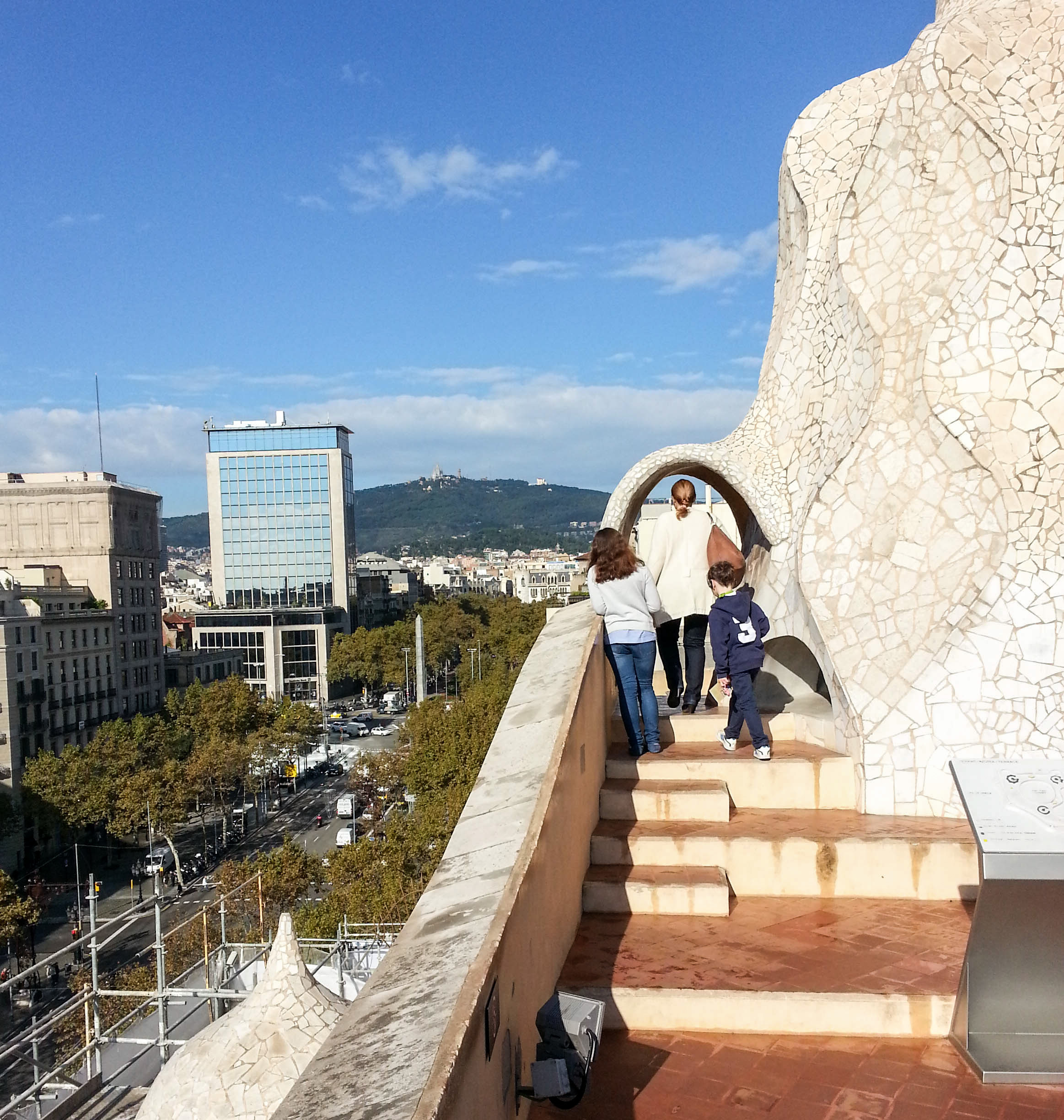
On the Roof of Gaudi’s La Perdrera Apartment Building
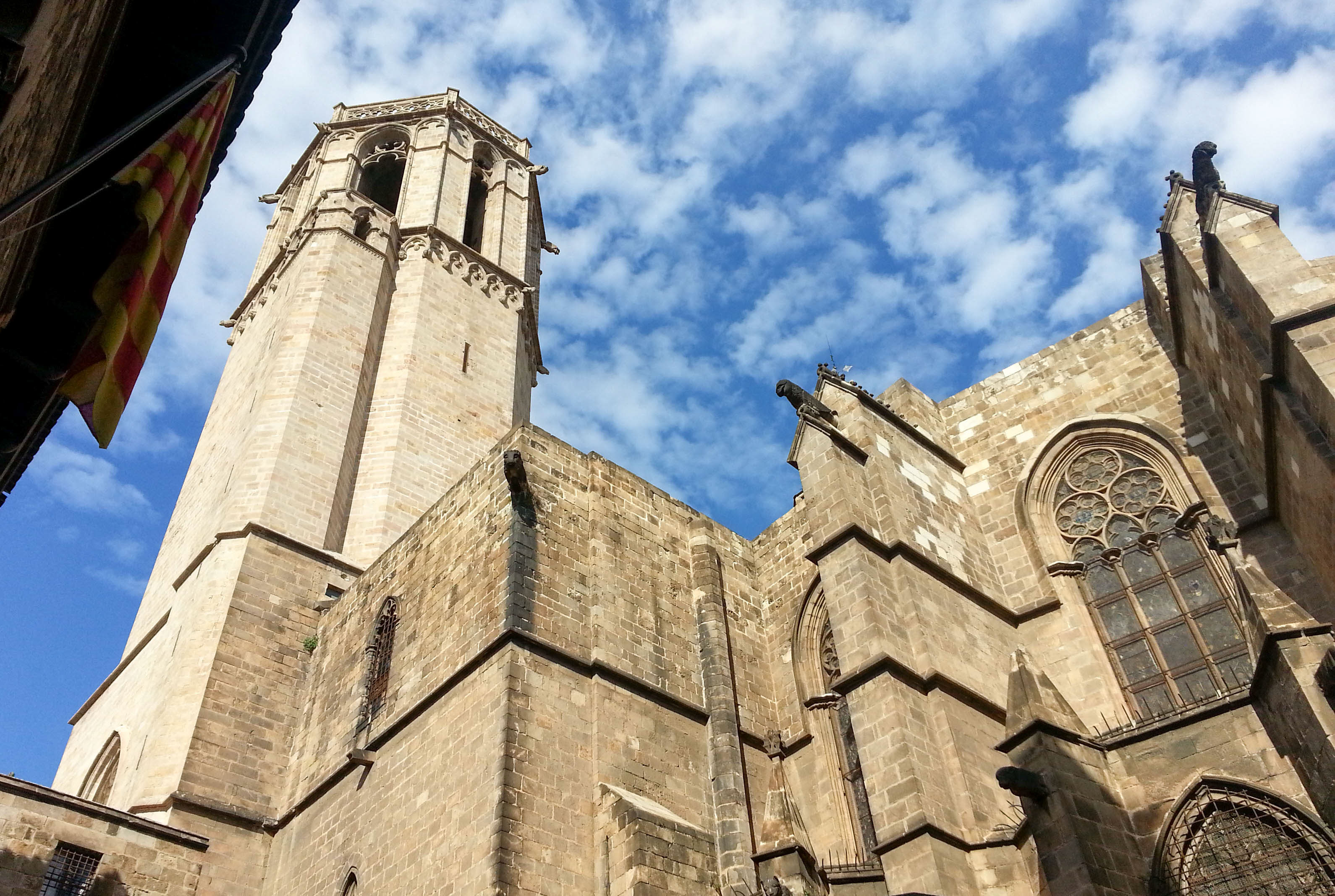
Next we follow the Passeig de Gracia eastwards towards the harbor. Crossing the broad Plaza Catalunya we enter the oldest part of Barcelona and explore the ancient Gothic quarter. We follow the avenues of Las Ramblas to the Cathedral of Santa Eulalia, a beautiful example of gothic architecture. My favorite thing is the flock of fat white geese in the courtyard of the cloister. The 13 geese are supposed to represent the short 13-year life of Santa Eulalia, before she was martyred by the Romans, but they call to mind the white geese in the temple of Juno in Rome. The first basilica was built upon this site in 343 AD when Spain was an important part of the newly Christianized Roman Empire. It was built on the site of a Roman temple, and for a while was a mosque when the Moors ruled Spain. In Spain we are time travelers, walking from a modern apartment along broad 19th century boulevards to a medieval walled city to a cathedral that was built over a Roman temple.
We find a café with outdoor seating in a plaza near the Cathedral and have lunch. Then we go back up Las Ramblas to the spacious iron-framed, covered market place known as La Boqueria. Seeing the huge variety of fruits, vegetables, meats, fish, cheeses and delicatessen-type foods, I want to have an apartment in Barcelona and stock it up for a month’s stay. And La Boqueria is only the most famous of Barcelona’s public markets. We finally choose a few things, carry our bags back to our apartment, and enjoy our treats with our feet up in front of the television. At this hour, five different stations carry the news in Catalan, and not one in Spanish. Lots of talking heads discuss the coming election, but we don’t understand much.

Dinner and Television in Our Barcelona Apartment
The next morning we visit the Sagrada Familia. We purchased tickets on line the night before. At this time of year it is not hard to get tickets, and the lines to pick them up and to enter the Basilica move swiftly. The interior spaces are glorious. It is nearly a century since his death, and Gaudi’s intentions are now almost fully realized, but workers continue to scramble up scaffolds as they complete the exterior of the building.

Inside, enormous tree-like columns give organic support to the towering roof vaults and multi-colored light pours in through the recently installed stained glass window-walls. I won’t write much about the this famous cathedral as so many images are available, but it is wonderful to be there within this amazing space. His concept of the pillars as trees that connect earth and heaven illustrates his deep reverence for Nature and his life-long effort to create an organic architecture that celebrates Life. When we leave we are saturated with Gaudi and need time to digest what we have already seen, so we do not also try to explore his extensive Park Guell during our too-short visit to Barcelona.

The Sagrada Familia Exterior and Interior
Frequent bus tours pick people up near the Sagrada Familia, so we decide to rest our feet by taking one, but it turns out that we have to walk a mile to the Passeig de Gracia for the tour we want. We retrace yesterday’s walk, wait in line for our bus near La Pedrera, and are finally able to get on and rest our feet. The bus makes a big loop through the old quarter and along the harbor, where we get off for a late lunch.
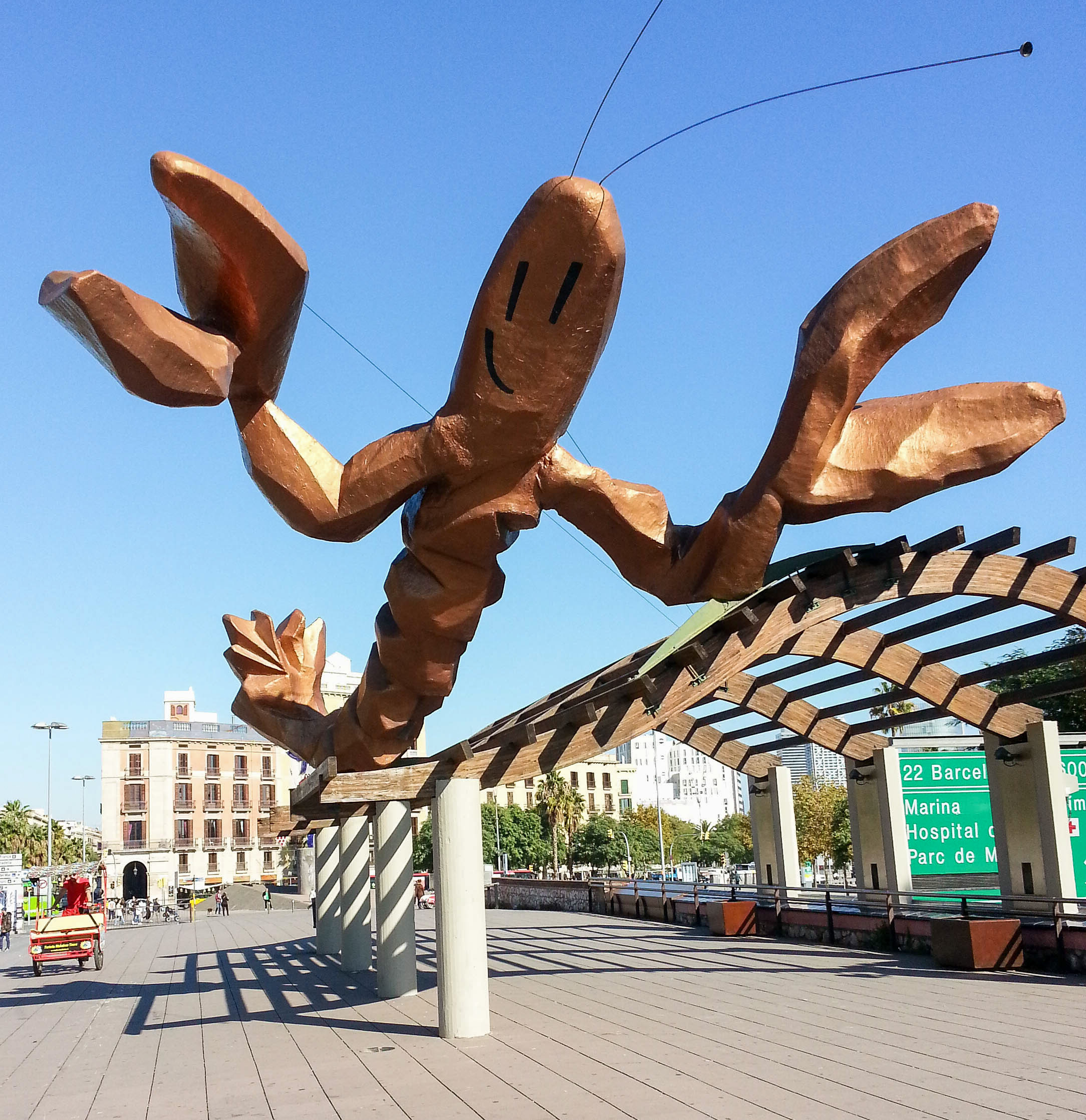
A tasty prawn greets visitors to the Barcelona waterfront
Eventually we choose a lovely restaurant at the water’s edge, where we have one of the more expensive meals of our trip. We sit outside and eat an excellent meal while enjoying the harbor view, thankful for the propane heaters that supplement the bright sunshine. We begin with a flavorful fish course, followed by a delicious seafood paella. What other city has a stature of a giant prawn such as La Gamba on the Barcelona Waterfront?

Paella
When we return to the bus loop, our new bus takes us up onto the Montjuic hill, giving us good views of the city. By the time the bus descends it is getting dark. It is November, after all, and as the bus plods through the heavy evening traffic the open air seating at the top of the bus gets colder and colder. We are grateful when we finally get off the bus and return to our apartment to warm up After a light dinner at a small neighborhood cafe, we pack and get ready to leave. There is so much more to see and do in Barcelona, but we move on.
 Feast Along the Flyways
No comments yet.